

FASHION
Cecilie Bahnsen

Present Continuous
words by Teneshia Carr
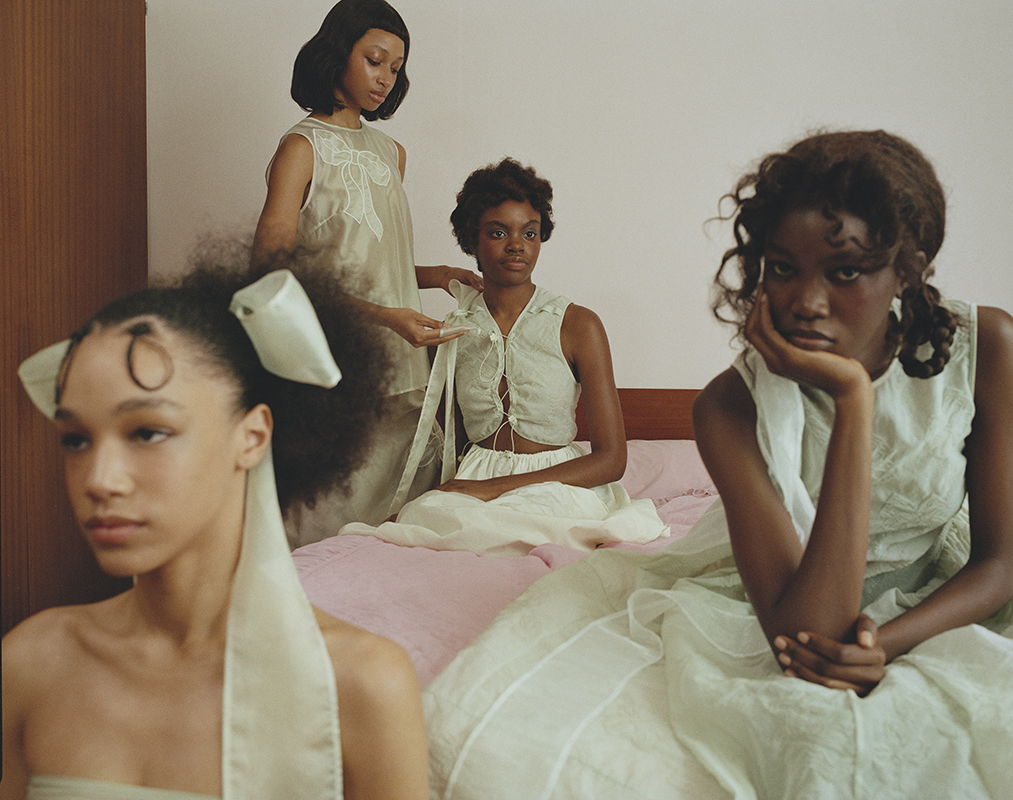
Cecilie Bahnsen speaks about fashion the way a choreographer speaks about movement. There is structure, but it holds space for instinct and whimsy. There is craft, but it remains open to interpretation. Nothing about the Cecilie Bahnsen woman feels fixed.
When we last featured her in Blanc, nearly a decade ago, her work already carried a distinct language. It was romantic without sentimentality, feminine without constraint. That language has since expanded into something more precise. The silhouettes remain recognizable as her intention has sharpened. What she builds now feels less like a collection and more like a living system.
We speak just days after her latest show. She is in the countryside, coming down from what she describes as a high. There is always a moment after a show, she says, where everything slows, and the weight of what was just released begins to settle. Each collection carries a personal investment and the aftermath holds both pride and a quiet recalibration. I couldn’t help but wonder, as her daughter bounces onto the screen, asking for attention, is Bahnsen already thinking about the next collection? This season, that recalibration takes on a different tone. The show did not resolve into a final statement. It opened into something ongoing, “All the models and dancers were on stage at once,” she says. “Everything was happening in one moment. It felt like letting go.”

That sense of release shaped the presentation’s structure. Traditional sequencing gave way to simultaneity. Instead of a monotonous procession of models, there was a shared space. Movement unfolded without hierarchy. The collection did not arrive in parts and instead existed all at once.
The inclusion of dance reframed the work entirely. It introduced a physical demand that required the garments to respond in real time. Dresses that once held volume now moved closer to the body. Bias-cut silks traced motion rather than resisting it. Skirts were reworked to allow extension, lift, and reach. Bahnsen speaks about this process in terms of practice. She references a Danish expression that equates repetition with mastery, but she resists the idea of perfection as an endpoint. The work remains in development with the show and the collection becoming a moment within a longer study. “I wanted people to see part of the development,” she says. “Not something that felt finished.”
In the studio, that development took on a collective form. Dancers and models shared space before the show, observing each other, adapting, responding. A kind of informal choreography began to emerge. One rehearsed while another documented. “It became women admiring each other,” she says. “Learning from each other.” That exchange extended into the garments themselves. The collection reflects a shift toward proximity. The softness remains, but it carries a different weight. There is a strength in the way the pieces sit against the body, in the way they allow movement without excess.
This attention to function is evident not only in her pieces but also in her collaborations. Bahnsen approaches partnership as an extension of her own language. When she first reached out to The North Face, the intention was direct. She wanted to build outerwear that could exist within her world. Something that could protect a dress without interrupting it. A jacket that could move between environments without requiring adjustment. The result sits between two systems of thinking with technical performance meeting decorative precision. Waterproof seams coexist with scalloped edges. Volume accommodates layering. Each detail serves both utility and expression.

“I wanted to make the perfect jacket to wear with the dresses,” she says. “Something you could use every day.” And she thought of everything, down to how the sleeves would look atop her puffy sleeves. That sense of daily use runs through her broader vision. The Cecilie Bahnsen woman does not reserve clothing for an occasion. She integrates it into movement, into routine, into landscape, into her daily life. The reference is Copenhagen—cycling in a dress. A raincoat layered without hesitation. Style exists as a condition of living rather than a performance of it.
Collaborations also operate as a method of expansion. They allow Bahnsen to test new categories while maintaining control over her core identity. Footwear, outerwear, accessories. Each enters the universe through dialogue before becoming fully internalized. “With each collaboration, we learn,” she says. “We understand what our language is in that category.” This approach has become essential within the structure of an independent brand. The industry has shifted, so stability requires adaptability. Bahnsen describes the process as one of navigation. Creativity functions as both expression and strategy. “You have to think out of the box,” she says. “You have to keep challenging yourself.”
That challenge does not extend to her core instincts. If anything, time has reinforced their importance. Reflecting on a decade of work, she returns to a single principle. Trust the internal signal. The moments where something felt off can be traced back to ignoring it. The corrections come from returning to it. “It’s about following your gut feeling,” she says. “And believing in what is yours.” That belief has allowed her to sustain a distinct position. Her work does not follow trend cycles. It operates on its own timeline. When something falls out of favor, she continues. When it returns, it does so on her terms.
Looking forward, the focus shifts toward completion. Not in the sense of finality, but in building a full environment. Bags, shoes, and smaller objects that extend the brand experience. Each functions as an entry point and a way for someone to encounter the work and begin to understand its logic.”I see them as small souvenirs,” she says. “The first piece of the universe.” That universe continues to expand, but it does so with restraint. Each addition aligns with an existing rhythm. Nothing disrupts the core. Back in the countryside, the pace remains steady. The show has passed, but its implications remain active. The work continues, not as a reaction, but as a progression. The collection exists, and exploration continues. Bahnsen does not close chapters. She builds through them.