

Kwesi Botchway: Reimagining the Black Portrait
Words by Jude Porter
Kwesi Botchway speaks about his life with a clarity that feels earned. Raised in Nima—a neighborhood often described in shorthand as a slum but to him a dense, complicated ecosystem—he recalls a childhood shaped by discipline, community, and the constant presence of many lives under one roof. He smiles easily when he introduces himself, the fatigue of the week softened by an unmistakable sense of purpose. “I’m doing amazing,” he says, and it’s clear he means it.
“I grew up in Nima and my childhood has been, you know, interesting because I grew up in Islam, but for me, it’s also a very interesting space… which I think really influenced my practice and also the way I live as an artist.”
He grew up in a family house—a distinctly West African structure of living and kinship. “In Africa, when someone says a family house, it’s like a house where there’s like cousins, uncles, everybody’s all together,” he explains. But it didn’t stop there. “Though it’s a family house, we had different families from elsewhere also renting some of the apartments, you know, living together with us. So I grew up in a diverse space where there were different cultures, different religions as well.”
At the center of that house, and of his early life, was his mother. “My mother is… she’s very wild, but also very calm as well,” he says, laughing softly at the seeming contradiction. “I feel like raising a boy, you have to be tough, you know. And, you know, growing up in a slum where it’s very rough… you as a mother, you have to be tough on your son to make sure he’s shaped well.”
That toughness translated into a childhood spent mostly indoors, away from the dangers of the street. “I was not allowed to go out most of the time,” he remembers. “I didn’t get much time to play with friends… most moms kind of keep their kids indoors, making sure that they don’t develop bad behavior, getting into drugs and certain unwanted stuff.” It wasn’t a fun childhood in the conventional sense, he admits, but it gave him something else: time, and a deep habit of observation.
It’s from that interior world that his art began. At school, Botchway drew through lessons, his attention more fixed on the margins of his notebooks than the front of the classroom. “I used to sketch in school,” he says. “I wasn’t really paying attention to school subjects… most of the time I’m just drawing. Some of the teachers would call me to come and draw on the board when it’s time for science and stuff.”
He spent time in the library drawing, slowly realizing that his love for line and form was more than a distraction—it was a direction. After school, his mother arranged for him to work with a street artist. His teacher, recognizing the obsession, pushed him further. “My teacher was like, ‘Kwesi, I know you love art, I know your direction. I don’t think it’s good for you to go and study other subjects. I know of an art school; I want you to go. It’s really going to help you.'”
He was sent to Ghanatta College of Art & Design. “When I went there, I was blown away,” he says. “I’m looking at people painting, drawing in all kinds of forms. I’m like, wow, this is where I really need to be.” From there, the work became more focused, more intentional, more professional. The language of his practice started to crystallize.
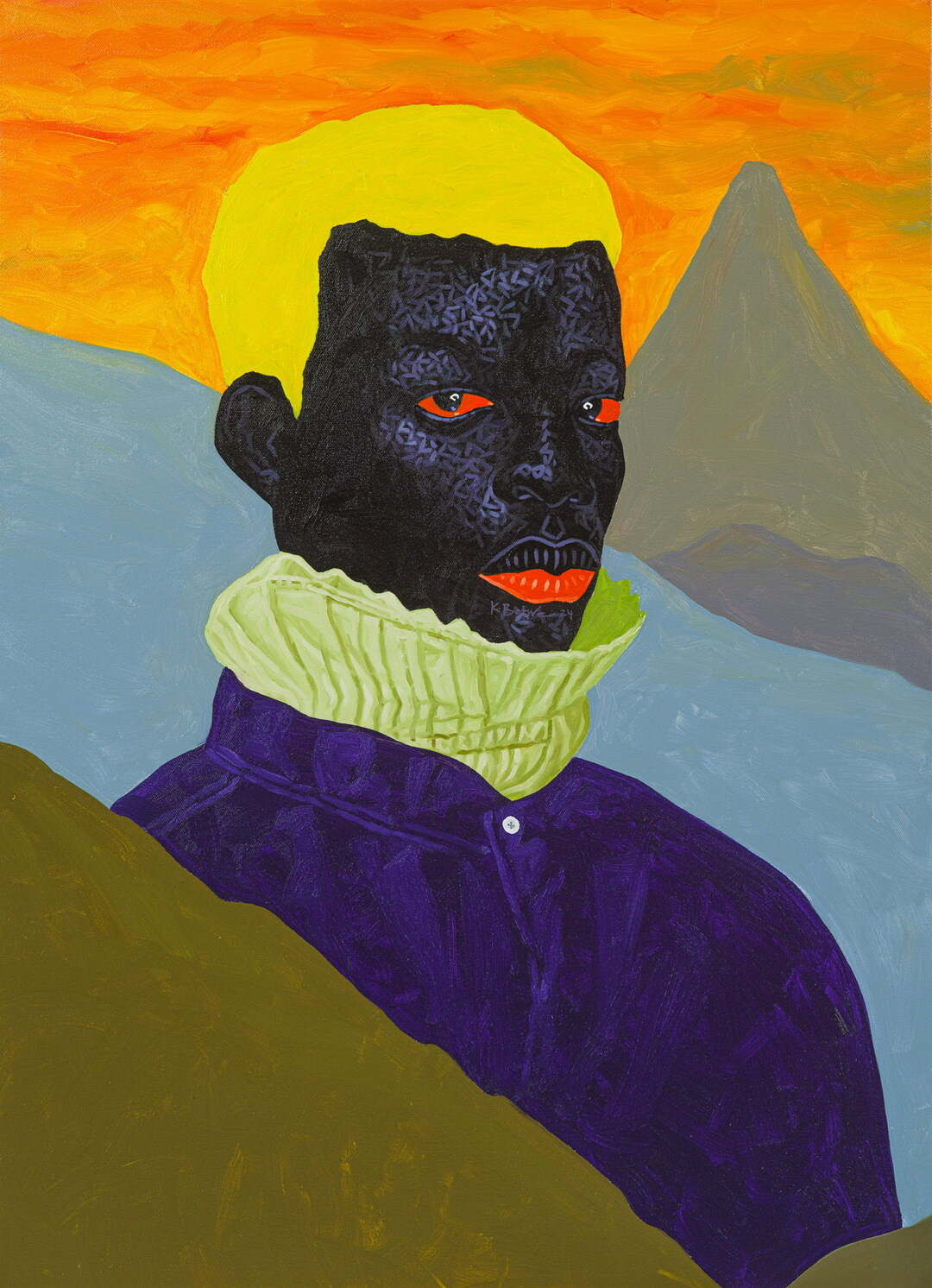
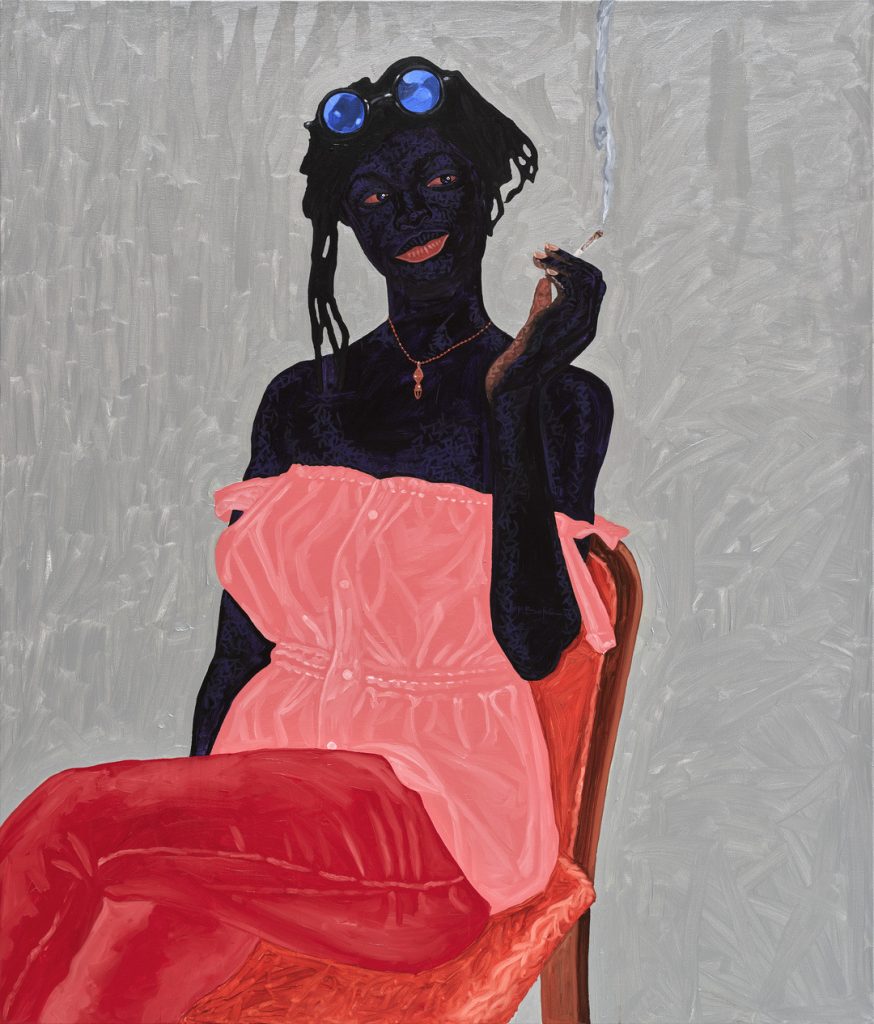
Today, Botchway is known for portraits that feel both quiet and charged—figures rendered in luminous purples and near-black skin tones, eyes often rimmed red, gazes steady and unflinching. They inhabit a space between calm and intensity, familiar and almost otherworldly. When he talks about why he is drawn to portraiture, he returns to the face as a kind of portal.
“For me, I feel the face is like the gateway or the portal whereby you communicate with humans,” he says. “When I meet you, the first thing I would do is look at you. There is some sort of connection that you gain or some sort of information that you gain when you come in contact with people, eye to eyeball.”
He is fascinated by the amount of information held in quietness. “Even when people are still and you stare at them, it really communicates to you more,” he continues. “You’re trying to investigate what the person is thinking or what’s going through the person’s mind. So that really draws me to portraiture. I’m very observant—I like to observe people, even from afar, not having communication with them. I try to put my mind in what they are doing, try to get some information, whether it is true or not. But these are some of the things that really interest me.”
Then there is his color—his now-iconic deep purples and intense dark tones. The palette is not an aesthetic accident, but a deliberate response to the environment he grew up in. “Growing up in a slum, there is so much going on,” he says. “There is a lot of skin bleaching… so much going on. Growing up as an artist, I feel like there’s so much inferiority complex. People are really not confident in their skin.”
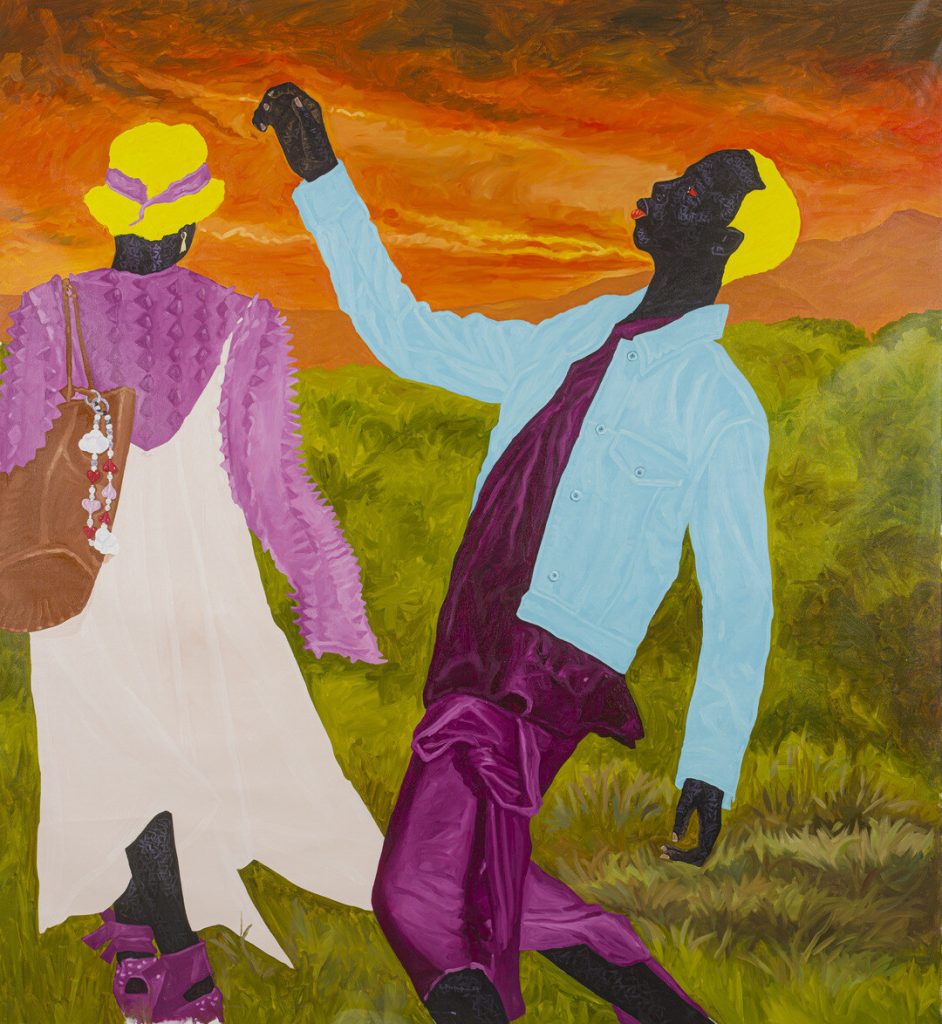
He wanted to address that directly. “I thought of how I could use that as a subject and also address this in my paintings,” he says. “The body of work itself is to elevate and correct certain misconceptions about Black people.” Purple, long associated with royalty and power, became central. “The color purple is essential to royalty, power,” he explains. “And black, which actually defines us as people, or as a collective people—I thought it to be very meaningful to put these colors together. It’s about showing the power and the dignity that we have as Black people.”
The turning point came, unexpectedly, from a conversation in New York. “I met this collector,” he recalls. “He asked, ‘Kwesi, what’s your favorite color?’ I’m like, my favorite color is black, because I really love black. He was like, why don’t you work around something black?”
At the time, Botchway was painting more naturalistic skin tones. He knew of artists working with black skin—Kerry James Marshall among them—but felt compelled to find his own version of that language. He began experimenting, trying browns with black, purple with brown, different combinations that didn’t quite land. “This one really sits well for me,” he says of the purple-black combination. “The moment I started painting with the red eyes… what I was looking for, how I was viewing Black people, the image just sat so well for me. Fierce, calm, powerful, love and beauty—I got everything from that setting. That really changed everything for me.”
If color is his way of re-inscribing dignity, then the overall presence of his figures is about reframing who Black people are in the collective imagination. “The point is to project greatness and also for Black people to reflect and understand who we are as people,” he says. “The works are very powerful, and it’s not just about painting people, but about positioning who we are as people.” He doesn’t mince words about the scale of that ambition. “I don’t see Black people to be normal people,” he says.
He points to history, slavery, racism, ongoing injustice, and the way Black communities respond. “We’ve been through a lot,” he says. “I don’t see us as normal human beings. I feel like we need to understand who we are as people and come together and empower ourselves.”
That centering of Blackness is not something he apologizes for, or softens, even amid the art world’s tendency to categorize. “It is what it is. I’m a Black artist,” he says plainly. “We will definitely be put in categories, but I still appreciate being Black. I won’t be shy of being a Black artist. I’m more concerned about my people. It’s like music—I can’t be singing white people’s music. I can only relate to Black people’s music or Black people’s dance more. For me, it’s the same with art. I’m more concerned about Black people and how I can elevate them through my practice.”
Accra is central to that practice. “As an artist, I don’t think you can work without connecting to where you’re coming from,” he says. “Accra has been my core connection. When it comes to creating, I look at Accra more—how can I put Accra into my work? Because I want to project what is happening now and also what will happen in the future.” He has watched the Ghanaian art scene transform from a time when there were “not much galleries to even attend” to the current moment of global attention. “I’m really excited to see this development happening in this era,” he says.
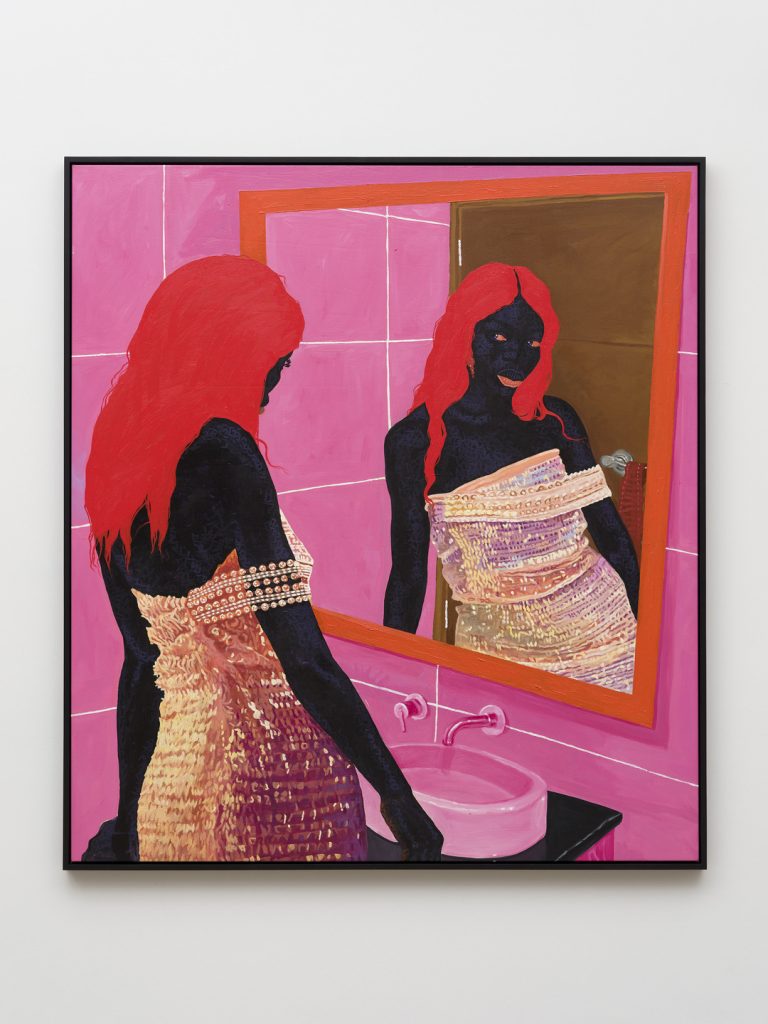
In the studio, his process shifts between planning and improvisation. He sketches compositions in a notebook, mapping out placements, arrangements, and relationships between figures. Other times, he goes straight to canvas, following instinct. He also challenges himself to draw from memory. “If I’m walking in town and I get across a person who is interesting, I try to put that image in my head,” he says. “When I’m in the studio, I try to sketch and get that person’s form, even though it might not be perfect. I just love the fact that I’ve seen someone and tried to get their resemblance.” Sometimes he works from photographs, resulting in portraits with a more “solid human feel.” Other times, the figures are softer, more mutable—echoes rather than exact likenesses.
Lately, the work has slowed down in visible production but intensified internally. “Now I think I’m really thinking wild,” he says. “I’m slowing down in the studio because I’m doing so much brain work.” He is looking more deeply into history and the spiritual dimension of Black life. “I’ve worked a lot on subjects talking about fashion and stuff like that,” he says, “but now I like touching on things that we really don’t pay attention to—or things that feel like too much to handle. I like to digest it in a form that people can appreciate.”
He is sketching, reading, thinking, letting the next phase take shape on its own time. In many ways, his life has been circling the same questions since those days inside the family house in Nima: Who are we, really? What do our faces reveal even when our mouths are closed? How do you take a people who have been told they are less, and paint them in the colors of royalty?
In Kwesi Botchway’s work, the answer arrives in the gaze, in the purple, in the quiet insistence of presence. The portraits look back. They know exactly who they are.