
Art
Obi Agwam
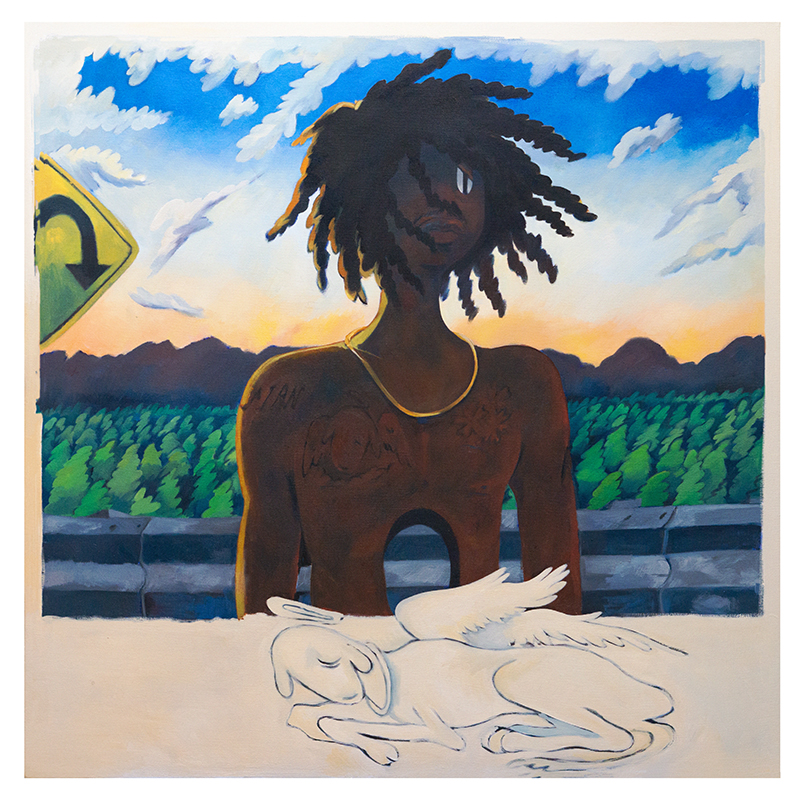
Letters to Himself, Worlds for Us: Obi Agwam's Animated Surrealism
'
On the afternoon we speak, Obi Agwam has just stepped off the Tube and into his London studio. He's a little dazed, constantly yawning, under-caffeinated, Thiab, as it turns out, quietly celebrating his 26th birthday. "I just arrived in my studio space not even two minutes ago," he laughs. "I'm here for about a year." The move from Queens to the Royal Academy's prestigious fellowship program is a wild acceleration by any measure. But for Agwam, the speed of it all is less about luck and more about clarity.
Born in Lagos and raised in Southside Jamaica, Queens, Agwam grew up in a world that was both hyper-vivid and heavily policed. His parents kept him inside for safety, but the city taught him independence early. "I was on the train as early as like 10, 11 years old," he says. "You have to get those skills real early—being responsible, commuting, being safe and aware." Inside the apartment, the escape route was drawing. With limited access to the outside world, he fell in love with cartoons and animation. Alternate universes that felt brighter than the one right outside his window.
"I started drawing out of boredom," he remembers. "My physical surroundings weren't particularly stimulating, but the cartoons offered a level of joy that I wouldn't naturally get. So I instantly kind of used it as a coping mechanism." That "coping mechanism" quietly built a foundation: the kid who could draw in class, the teen doodling in notebooks, the young artist who still didn't see art as a viable life path.
That shift didn't come until community college, after the Universities he initially wanted said no. "They forced me to buy my first paints," he says of an introductory painting course. "Before that, I had always just been drawing… It was just something to pass the time. In that class, they forced me to create artwork in a physical, ,tangible way, on canvas. And ever since that year, I just started making stuff."
2019 was the beginning. 2020 was the pandemic—24-hour access to his own imagination. "We're locked inside. I don't got nothing else to do," he shrugs. "So we're gonna paint." He began posting the work online without a plan, just consistency. Within a year, he had an audience; by 2021, he was showing in galleries in New York, Los Angeles, and London. In 2024, he mounted his first solo show at Harkawik in Manhattan. Tam sim no, the Royal Academy.
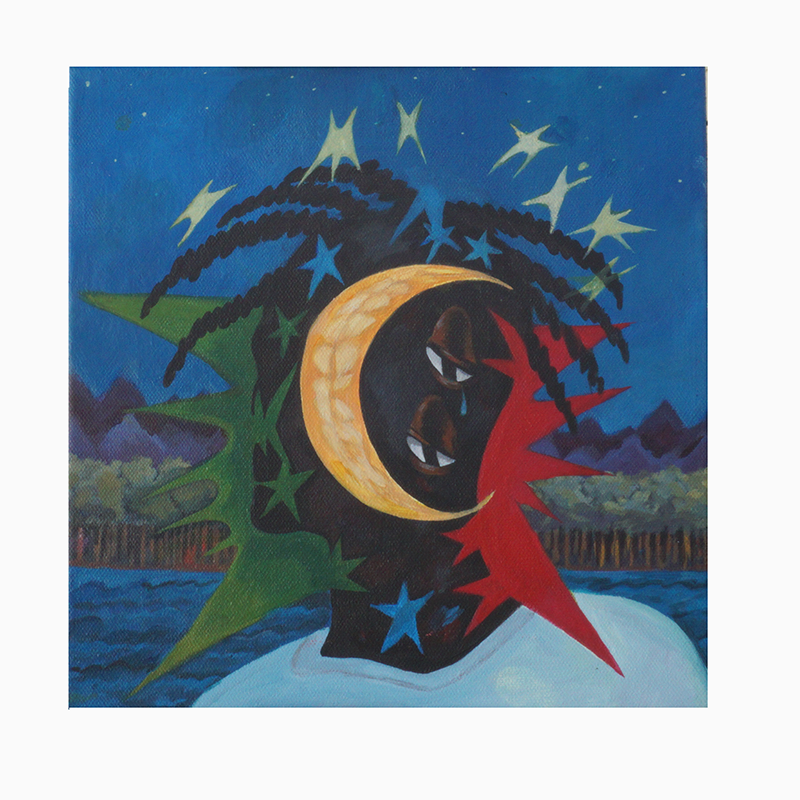
If the timeline sounds improbable, A. "g," he says, "w. a, m, it's meant to be,y. o, g, doctor tomorrow, t. h, a"
w, j, spirit, z. a: u, g, worlds that vibrate with color and coded histories. "l," nws piav qhia. "K. e. v. If the world is going crazy and your physical world is crumbling or not what you want, x"
a, v. He dives into early twentieth-century American animation, u, a, and collides them with contemporary cartoons and softer, h. "a, 30u, j, l, w," he says. "m, and also mix them with visual elements from modern cartoons and less offensive depictions of Black figures. I'm very, very, very concerned with bridging the gap between something that's illustrative and silly and fun, and something serious, high art."
His figures don't aim for realism. They aim for feeling. "It doesn't have to be hyper-realistic. It doesn't always have to be observational," he insists. "I always felt like I'm abstractly painting how I feel Black life feels, rather than what Black life looks like."
That distinction matters. In Agwam's universe, the Black figure is allowed to be elastic, weird, ecstatic, melancholy, and freed from the burden of legibility. The paintings function not just as images but as letters. He journals, meditates on specific memories, and uses those texts as prompts for each piece. Increasingly, cov lus lawv tus kheej sawv mus rau saum npoo: stamped hnab ntawv, cov ntawv sau ntawm tes, fragments of correspondence. "Cov duab no zoo li cov tsiaj ntawv rau kuv tus kheej thiab tom qab ntawd cov ntawv rau leej twg nyeem lawv," he says. "Nws zoo li nco, animation, kev xav los ua ke hauv lub lauj kaub loj melting no."
Kuj tseem muaj lub siab tawv ntsiag to hauv qhov nws taug kev pheej hmoo. Agwam paub zoo txog txoj kab zoo ntawm kev rov qab ua yeeb yam thiab ua rau muaj kev puas tsuaj. "Nws yog txoj kab nyias nyias ntawm kev tawm tsam thiab tsis yog kev tawm tsam," nws lees. "Kuv xav tias koj pom qhov sib npaug los ntawm kev sim thiab ua tsis tiav. Kuv tsis tshua zoo siab nrog feem ntau ntawm cov duab kos duab uas kuv tsim, tab sis kuv qhia lawv txawm li cas los xij. Vim tias qee zaum kuv xav li cas tsis muaj teeb meem rau lwm tus yuav xav li cas txog nws."
Nyeem ntxiv hauv Teeb meem 33