

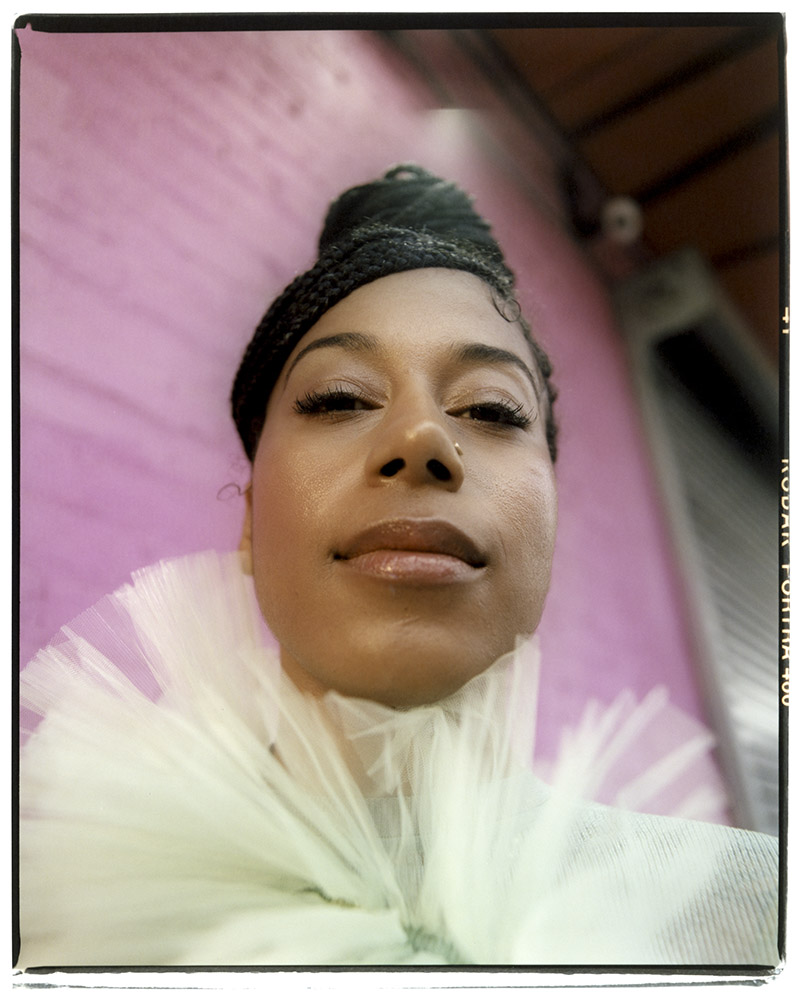
Photos by Thalia Gochez
The acclaimed poet speaks with Blanc about vulnerability, creative courage, community, and finding her way back to poetry as an essential act of self-love.
As one of the most impactful voices of our generation, Aja Monet spins magic with her words, weaving tapestries of thought that provoke, inspire, and echo truths often left unspoken. Her primary motivation is beauty, but who exactly is Aja Monet? Why does her poetry resonate so strongly with us?
Aja Monet, best known as the youngest person to win the Nuyorican Poets Café Grand Slam Champion title, is not just a poet but an activist, a musician, and a thinker. Her work seamlessly blends raw emotion that is often felt but seldom articulated. Monet’s poetry lifts the veil on the human experience, giving us a fresh perspective and challenging us to confront our own truths with political acumen. It gives voice to thoughts and feelings we have all felt but struggled to express.
TC: I read somewhere that you said that you were more afraid growing up of the police in your neighborhood versus the people in your neighborhood because, I don’t want to butcher it, but just watching your Black men in the neighborhood be victimized and arrested daily was the thing that gave you trauma. Did that trauma guide how you first started to write, express yourself as an artist, and how you decided to move?
AM: No, not at all. I think, basically, for me, it wasn’t seeing just people being arrested. It was seeing the hyper-surveillance state of living in a Black community and when it came to policing. The presence of police, the tone, the energy, and the posturing were a big part of just you recognizing when people are warm and coming into your community with a sense of enthusiasm, exhilaration, and collaboration. I mean, that was never the energy that I ever felt from people who were police officers. But to be honest, that is just one part of my childhood that isn’t the totality of my childhood; that isn’t even the totality of my experience in this world with my community. What I think is frustrating, at least about the way that some people tend to write about me or my work, is that they like to limit it or put it in a sort of “what they think is an activist box.”
And what that does not for me, but for them, is limited the scope of what they understand that I’m doing with my poems, right? How I came to poetry, like poetry, while it is a liberatory practice, it is something that I have felt deeply is a tool and a way to exercise frustrations and express the issues and grievances of my community or the things that I’m grappling with, I mean, I would say that it is the language of my heart. It is the way that I move through the world. It’s how I see the world; it’s how I engage the world. And a big part of that is a deep relationship with beauty, with joy, with celebratory homage to our Black radical tradition. It’s understanding how rich how vast and how full our communities are. And it’s a place where I was able to go when I couldn’t find anywhere else to communicate what I was feeling or expressing.
But I am deeply in love with people, with rich, diverse, all-encompassing, animated people. And I’m curious about our communities. I’m curious about what makes people tick, what inspires people, what keeps people, and what gives people courage. I mean, all of these sorts of very integral human qualities and characteristics that I gravitated towards as a child come from really more what I love and what I celebrate than what I’m against and what I’m fighting. And so I think sometimes people position our experience in the world as if we are constantly in this state of boogeyman oppression.
TC: Have you noticed anything about your development and growth as an artist over the past few years that you honed in on as you mastered your craft?
AM: Yeah. How do I say this? Poems are how I orient myself in this world. It’s an imperative impulse for me that I was not necessarily in denial about, but I did not give the credence that it deserved in prior years. I just loved my ability to be open to learning and growing. And I think that because of that, I’ve been able to develop my perspective and my craft while I was in the community, and organizing the poem took shape more in the form of embodiment and curation. It was the way that I was connecting to the community, the way that I was trying to bring more people together and deepen our relationships with each other and the world around us. And I think that was a sort of poem, that was a kind of doing that I am so grateful for because I learned so much about the human experience, the implications of a poem being embodied, a poem being a way of life, a poem being a perspective.
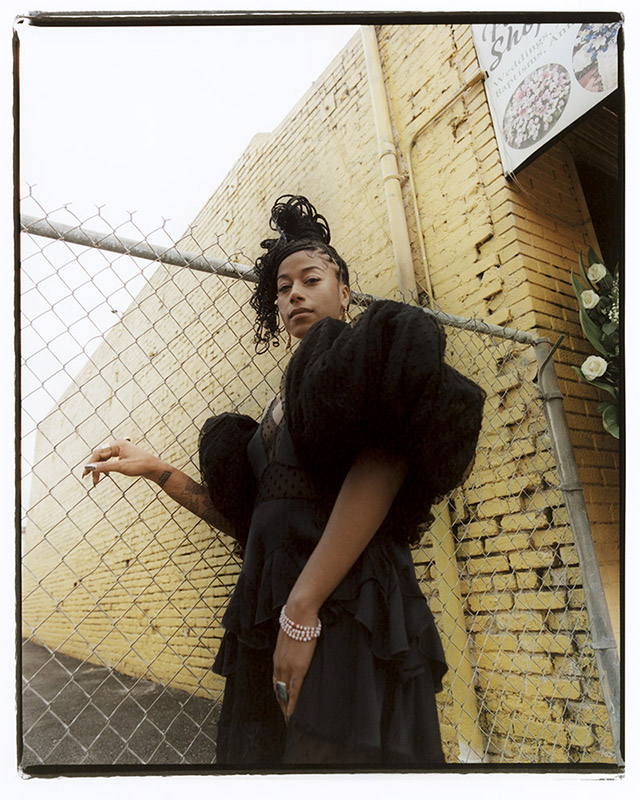
Full Look – Stella McCartney
I think now in this time, I am afforded the time to write, you know what I mean? To get to the point where this living is now… I’m finding language. I’m better at accessing the language to articulate the depths of my interior world and the profound relationships that I’ve been able to share in that expression. I’m also stepping into my musicianship, the musicality of language, the musicality of the poems. And I’m more courageous as an artist. In some ways, I hid behind a lot of things. I think I was hiding in many ways from fully expressing or going into the depths of my poetry as a practice and as a pursuit.
TC: Why do you think you were hiding?
AM: People are not always kind. To be a good one, requires a sense of vulnerability, and one is quite sensitive to that vulnerability. That you wonder if people will be able to carry you in that vulnerability. And some things happen in one’s life that makes the spirit ache, and you wonder if you could ever find language for but loss and grief and love. I think there was a time when I was really seeking the approval of the intimate personal relationships in my life that I don’t think fully made my poems feel safe or appreciated. And now I know how much a part of that is for me. For example, I did not know before that I wanted someone as a partner in my life that I could recite my poems to and that they could give me sincere, held feedback. I think before I thought in my life, I thought, oh, I guess I can do without them being super engaged in my work.
I settled for that. I was settling for the sake of the need and want and desire for love and companionship and connection and family, which, to be fair, I’ve never really had. You negotiate what the needs are of the relationship. And so sometimes you hide parts of yourself that you think aren’t as valuable to people in your life as other parts of yourself. And I don’t know if it was a conscious decision. I think it was just by way of the way that one moves when you’re in love and when you’re engulfed in your experiences. And to be honest, there were other skill sets that I have that were so powerful that I was being fed in other ways. I learned to appreciate the poetry of that. I learned to find poetry in the community that we were creating and that I was cultivating.
In my way, I belittled what I thought I was doing with a poem. I still wrote poetry for sure, but it wasn’t my end all be all. It was the thing that I did on the side when I got some time or when I felt moved and compelled, but I didn’t make a practice of it for a certain amount of time. Growing into the woman I am today, I know certain things about my gifts with language that I didn’t think I understood fully before. I didn’t know that there were people and mentors in my life who reminded me of the value of a poem and me writing and reciting my poetry at times when I needed it. I know now that I need to be in a relationship with people who can understand that value and create the sort of container for compassion in the craft.
I need that to sustain my livelihood in my heart, in my soul, in my spirit. Because at the end of the day, I didn’t realize that the reason why I would get frustrated or anxious or agitated easily was because I wasn’t writing. There would be moments where I’m like, what’s going on? Why am I just waking up with a funk? And it’s because this thing is knocking on my head, knocking at my chest, and it’s saying, sit with me, sit with me, sit with me. Come on. I need you to sit with me. Write this thing. This needs to come out.
But it’s a process that one has to invite and be aware of that everyone, so long as you’re living, you must grow, and you must seek to grow in your relationship, not just to the people around you, but to yourself more deeply and more necessary than ever. You have to learn, well, what are the things that make me tick? What makes me dream? What makes me feel inspired? What makes me feel purposeful and motivated? And a poem does that for me. And I think other things do that, but a poem does it in a way that I cannot neglect because if I neglect it, I start to resent myself.
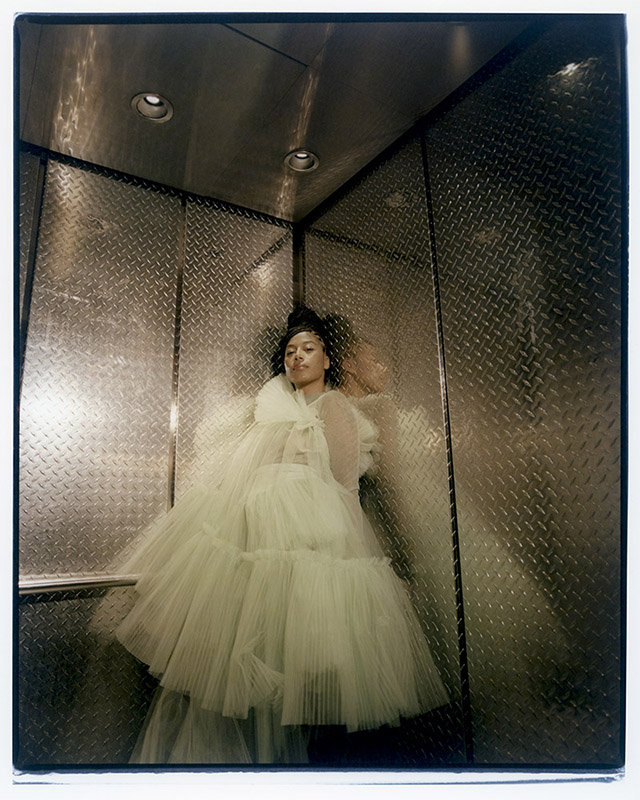
Full Look – ADEAM
Read the full story in Issue 26
Photo Shoot Credits:
Photography Thalia Gochez
Fashion Editor Oliver Vaughn
Hair Sharif Poston
Makeup Luigi Chamorro
Styling Assistant Dakota Wallace