

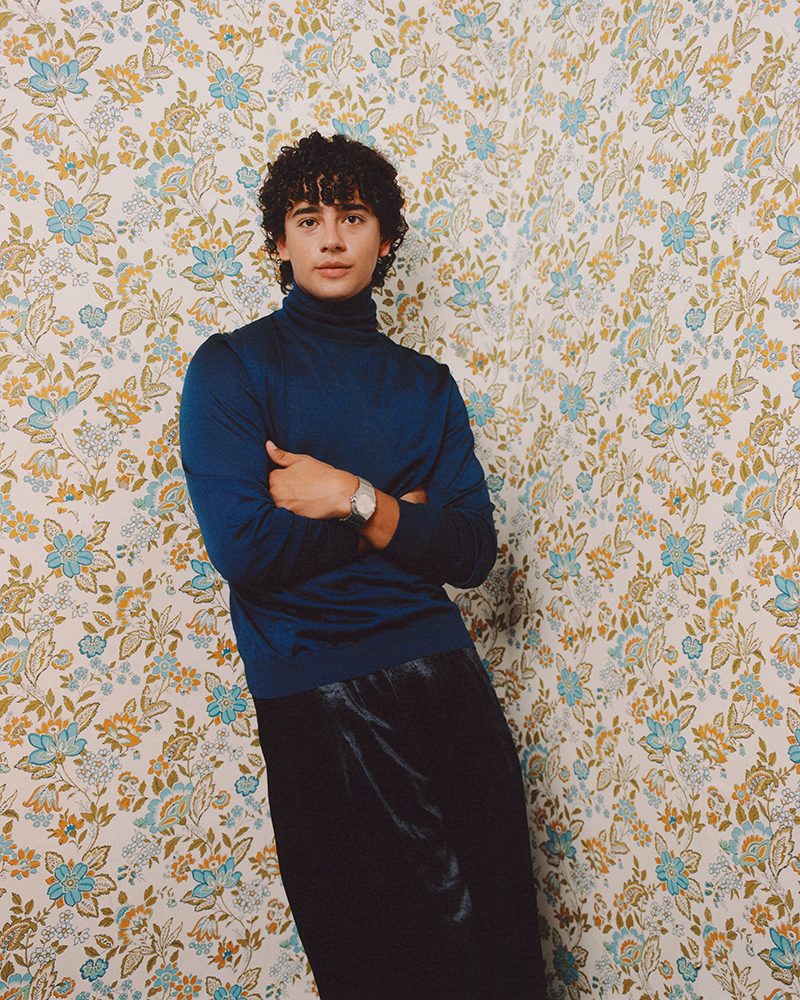
On family, Iranian heritage, and trusting his instincts, Kingston Rumi Southwick is finding his own way into the frame.
Written by Teneshia Carr
Kingston Rumi Southwick has the kind of name that seems destined for a marquee. Each part carries its own history. Rumi comes from the 13th-century poet whose words appear throughout the calligraphic artwork of Southwick’s Iranian grandfather. Kingston marks January 15, the day he was born and the birthday of Dr. Martin Luther King Jr. His parents decided their son was “the king,” and the name followed. Most of his friends simply call him King.
“My parents wanted to outdo themselves, I guess,” he says, laughing. His younger sister, Soraya Rose Southwick, was given an equally lyrical name.
The story offers an early glimpse into Southwick’s life, where culture, art and family have always existed in close conversation. His mother was born in Iran and left at three because of the country’s political regime. Her family first settled in Germany before she moved to California, eventually studying in Italy and France. Relatives dispersed across several countries, creating a family map that extended far beyond Los Angeles, where Southwick was raised.
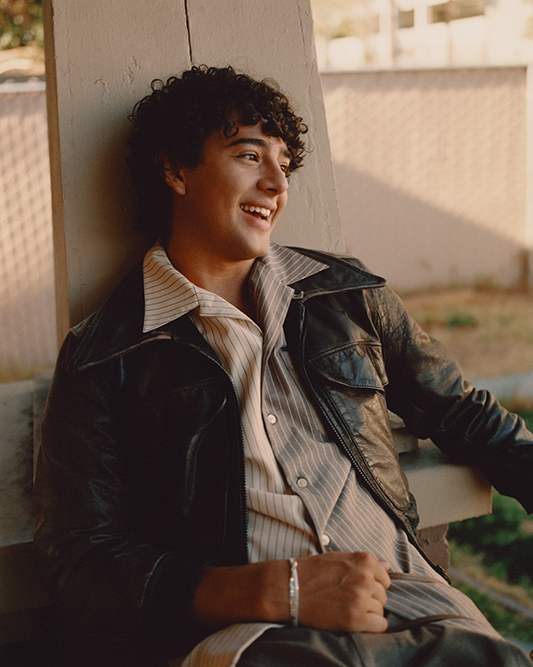
“My mom was very keen on me and my sister growing up not just in L.A.,” he says. “She wanted us to have a sense of the world.”
ravel became part of his education. It also gave him a different understanding of heritage, one untethered from a single location. His culture appeared in homes across France, London, and elsewhere, preserved and reshaped by family who had carried it with them. “Whenever we would travel, it was interesting seeing my culture and my heritage in all these different places and thriving in those places,” he says. “I knew I could go somewhere in the world and have family there who were just as supportive.”
That sense of support remains central to Southwick’s life. At 18, he stays close to his parents, especially his mother, who often accompanies him to sets and meetings. Her presence offers continuity inside an industry built around constant movement. Southwick may have entered a world that encourages young people to grow up quickly, but he does not confuse independence with having to move through it alone.
His career began with an intuition he could not fully explain. During his freshman year of high school, before he had an agent or any certainty about what came next, Southwick told his mother he didn’t believe he would stay there for four years. “I don’t know what is going to happen,” he remembers telling her. “I just don’t see myself being here.”
Soon afterward, he submitted a self-tape for Presumed Innocent, the Apple TV+ legal drama starring Jake Gyllenhaal and Ruth Negga. The process unfolded with unusual speed. He taped on a Thursday, celebrated his birthday that weekend, and learned the following Tuesday that the network had approved him. By the next Thursday, the role was his.
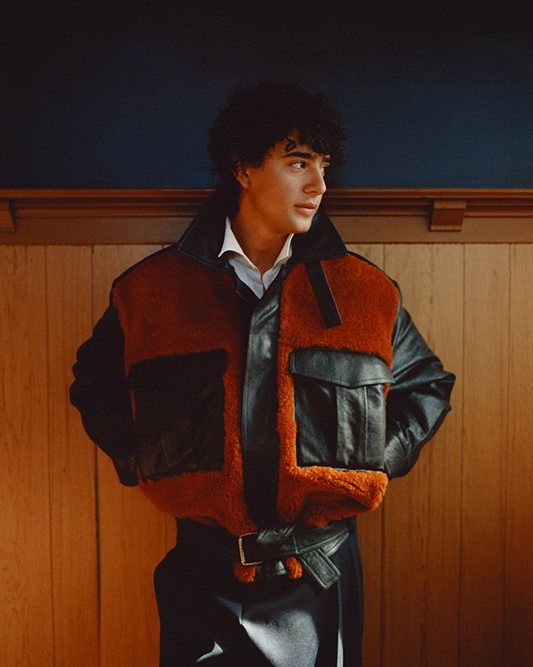
The six-month production moved his education online. Each time Southwick considered returning to a traditional classroom, another project arrived. He eventually spent a summer accelerating his studies and graduated with honors ahead of schedule. The decision allowed him to work adult hours and audition for characters closer to the age he appeared on screen. It was a practical choice, but also another instance of Southwick trusting a feeling that his life was moving somewhere specific before he could see its full shape.
“Everybody was like, ‘From 14 to 17, you’re not going to book anything,’” he says. His response was immediate: “Let me be the exception. I’ll work hard.”
That mix of confidence and curiosity shows up in Widow’s Bay, the Apple TV+ horror comedy in which Southwick plays Evan, the restless son of a mayor determined to present their cursed island as a perfect seaside town. Evan could easily have become a familiar caricature: the angry teenage son who enters a scene only to roll his eyes, provoke his father, and disappear. Southwick wanted to understand what lived beneath the attitude.
“I didn’t want to play him like that,” he says. “The story does so much more justice if you feel for him.”
Working closely with Matthew Rhys and creator Katie Dippold, he began constructing the emotional history beneath even the simplest exchanges. Evan has grown up without his mother and with a father devoted to maintaining the appearance of order. He does not always possess the language to express what he needs, so affection, resentment and confusion emerge through defiance.
“The way that I express my love toward my dad, or my hate toward my dad, or my confusion toward him, is by lashing out and maybe seeking attention,” Southwick explains. “There is so much unrequited and unspoken love that we have for each other. It’s not expressed in the right ways.”
His sensitivity to that unspoken love gives the performance its shape. Evan can be difficult without becoming disposable. As the story deepens, the character’s sharpness begins to look less like indifference and more like a longing to be understood. Southwick recognized that the series would carry more emotional weight if the audience kept rooting for him, even when Evan didn’t make it easy.
Away from the screen, fashion has become another expanding language. Southwick speaks enthusiastically about working with stylist Enrique Melendez, whom he trusts to help shape how he presents himself. For a young actor whose public image is still forming, clothing offers a space for intention, experimentation and play. He is already imagining future menswear shows in New York and Milan, even as his filming schedule keeps interrupting those plans.
His next project takes him into romantic comedy, a genre he has never explored before. It is another new world, which appears to be exactly what attracts him. Southwick’s career is moving quickly, but he has retained the openness of someone still delighted by the work. He talks about our shoot in terms of the friends he made, the clothes he discovered and the pleasure of being photographed on film for the first time.
At 18, Southwick is still becoming. He is learning what kind of performer he wants to be, what stories hold his attention and how he wishes to be seen. Yet the instincts are already present. He follows character over category, emotional depth over easy answers, and curiosity wherever it leads. Years ago, he told his mother that something was going to happen. Now, in the midst of it, he seems ready to discover exactly what that feeling meant.
Find the Full Story Here
Photo Credits
- Photography: Ryan Pfluger
- Fashion Editor: Oliver Vaughn
- Grooming: Sonia Lee for Exclusive Artists using Dior Beauty