
Konscht
Emma Larsson
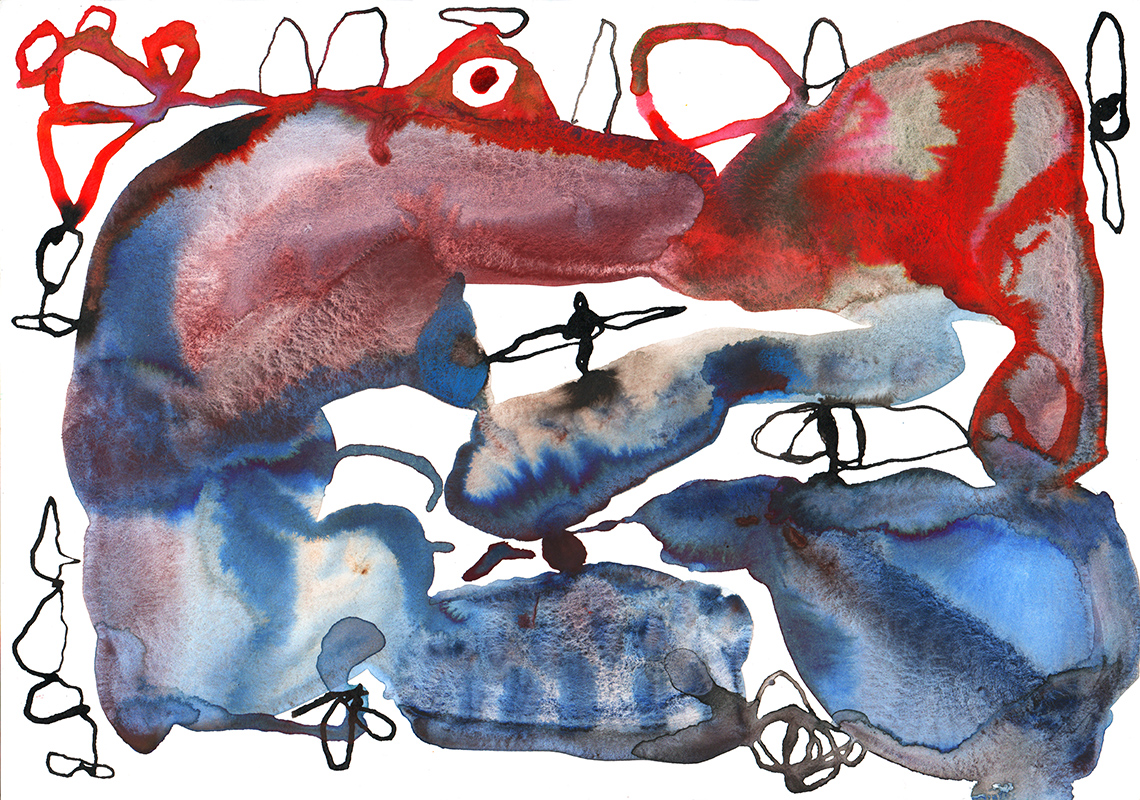
Where the Water Dreams
The Living Worlds of Emma Larsson
words by Maya Ellison
Emma Larsson paints the way a forest grows; organically, instinctively, without blueprint or hesitation. Her works, often described as botanical, biological, or even extraterrestrial, resist classification. They breathe, pulse, and stretch across the page like living systems of pigment and intuition. To stand in front of one is to feel momentarily submerged in an atmosphere rather than an image, a world built not from observation, but from sensation.
"I always create from a source within," Larsson says. "I rarely know or have ideas of the final result." Rather than approaching the paper with a plan, she approaches it with a kind of trust. Her process begins with arranging the colors, tones, minerals, and textures she carefully selects on cardboard plates. But once water hits pigment, intention gives way to instinct. "I build as I do with clay," Si erkläert, "but instead with water on paper. Things take shape and I love those moments of surprise."
Surprise is more than a byproduct; it's her collaborator. In a world addicted to control, Larsson's willingness to relinquish it feels quietly rebellious. Watercolor, with its own will and temperament, demands humility. When to intervene and when to surrender is a delicate line. "That's one of the difficult parts," Si zouginn. "But I've learned by now to stop and let go. Overworking can happen too easily."
This relationship to letting go gives her paintings their vitality. They feel as if they've emerged rather than been composed, as if Larsson has summoned something rather than constructed it.
While Larsson never paints nature directly, the natural world is her atmosphere, her origin point, her comfort. She speaks about nature not as scenery but as presence. "It is probably the life force inside the room of nature that I love most and feel safe with," si seet. "I want to catch that energy and power as I interpret it."
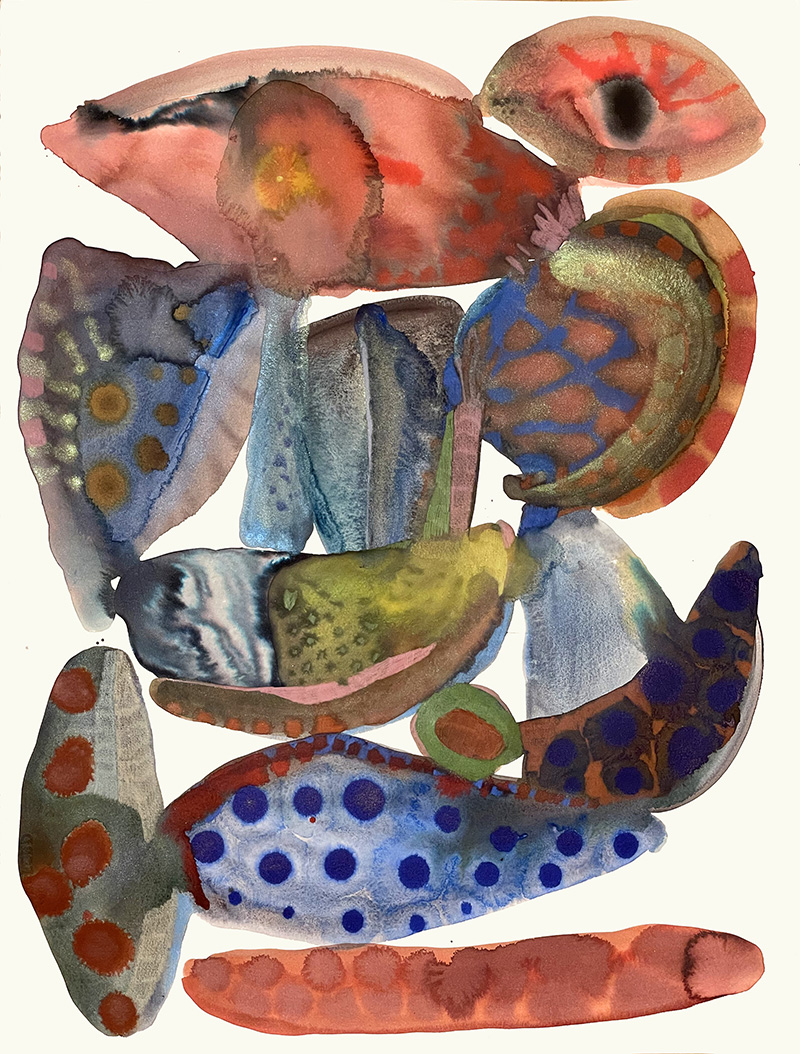
Her paintings carry that intention: the expansion of a leaf unfurling, the slow drift of underwater plants, the rhythm of roots coiling through soil. But they are not illustrations. They are interpretations of energy—fluid, sculptural, balanced, and free. This freedom is nowhere more apparent than in her use of color. Larsson works with pure pigments made from minerals, and sometimes blends them with clay, sand, or materials gathered outdoors. "I've always been a colorist," she reflects. "That's probably my earliest memory. The love of color." Her palette is instinctive, yet precise—tones that hold the emotional weight of memory without ever becoming literal. Texture, och och, plays a vital role. In a single painting, a viewer may encounter haze and density, softness and grain, washes that breathe beside pigment that sits with geological weight. "All expressions are welcome in painting," si seet. In her hands, watercolor becomes both atmospheric and architectural.
Although viewers often describe her work as landscapes or biological forms, Larsson sees them instead as internal reflections. "I think they are more like a sort of self-portraits," Si erkläert. "They end up there on paper and I don't know where they come from. They are more spun from curiosity, Energie, vitality, and emotions than from physical reality." This framing reveals something more profound about her work: each piece serves as an emotional imprint. Hir "avant-garde watercolors," as she calls them, are visual diary entries. They are moments where color becomes thought, gesture becomes memory, and instinct becomes documentation. They record not what the eye sees, but what the inner world feels. Her spontaneity, far from being a loose or casual approach, is her discipline. "Spontaneity is my signature," si seet. "The water and the pigment are wild together, and I try my best to control them, but it's almost always at the point where I give up that everything falls into place."The moment she lets go, the painting reveals its truth.
When asked what she hopes viewers feel in front of her work, Larsson offers a response as simple as it is profound: "Maybe the answer is that I hope they should feel alive looking at it." Alive is the perfect word—her pieces vibrate with motion, emotion, and possibility. But the world inside her paintings is not just alive; it's otherworldly. When she imagines stepping inside one, she describes a dream-state: "A world where just anything could happen." Her work operates like a portal, an entry point into a psychological landscape where boundaries blur, and logic dissolves.
As her practice evolves, she remains committed to exploring these internal terrains. "I will continue to experiment with my avant-garde watercolors," si seet. "They are like mindscapes—emotion-based and intuitive visual diary entries." Emma Larsson's work is a reminder that not all mastery is built from precision. Some mastery comes from listening to materials, to intuition, to the quiet knowledge inside the body. Her watercolors move the way emotions move: unpredictably, beautifully, with depths that reveal themselves only when we stop trying to control them. In Larsson's world, water is not just a medium but a collaborator. Color is not decoration but feeling. And painting is not a performance of technique; it is an act of surrender.
Her works don't just show us the unseen; they invite us to inhabit it.