

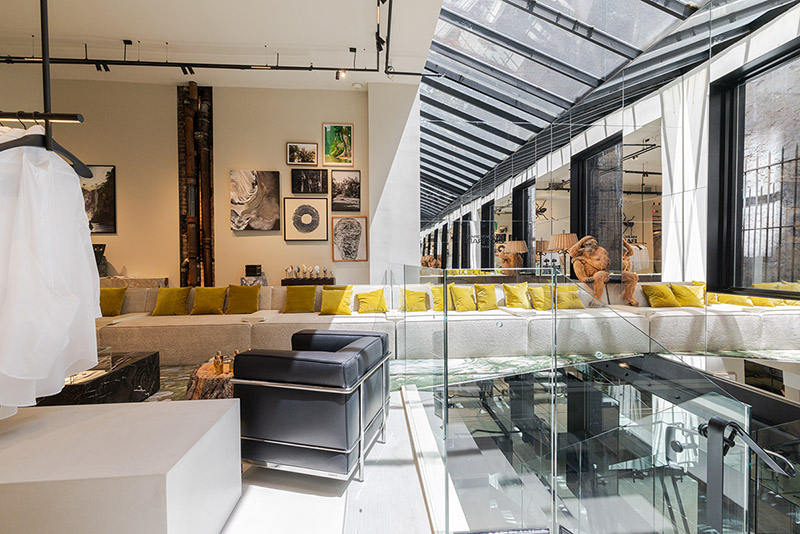
In his new SoHo flagship, the French couturier and fragrance designer brings together perfume, art, furniture, memory, and fantasy to create a world where every detail has meaning.
Images Courtesy of Designer
Words by Teneshia Carr
At 120 Wooster Street, two enormous black ants stand near the entrance of the new Marc-Antoine Barrois flagship. Sculpted by French artist Jean-François Fourtou, they represent patience and perseverance. They are whimsical, slightly surreal, and entirely sincere. Like almost everything in the space, their presence carries meaning.
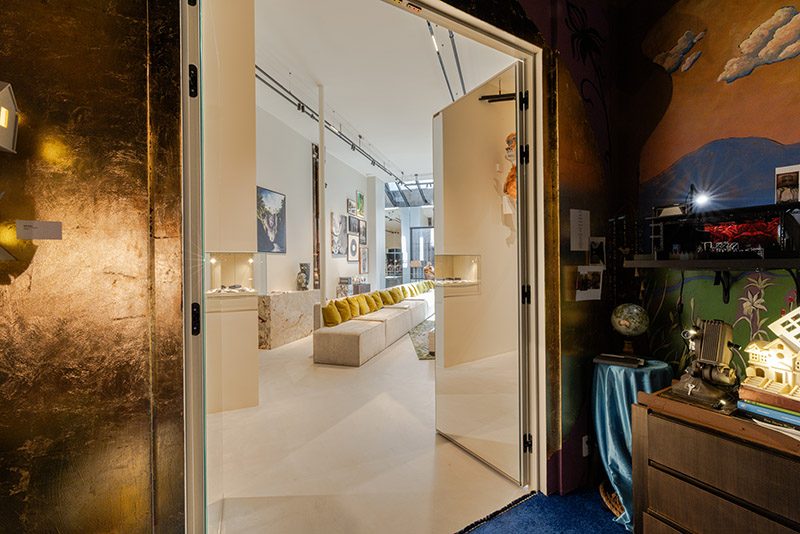
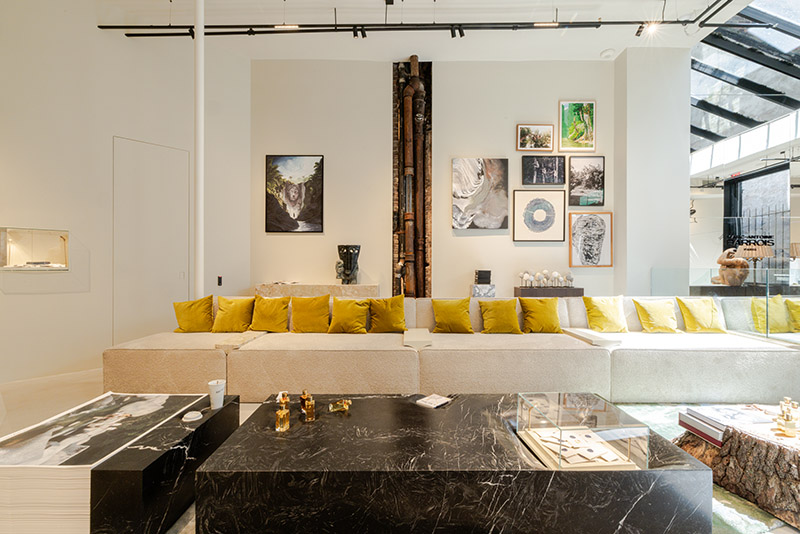
The SoHo boutique is the Maison’s first American flagship, following locations in Paris and London. Fragrances are displayed on carved sycamore stands that rise from the concrete floor like mushrooms. Glass panels created by the French atelier Grav’or are finished with maple sugar and natural earth pigments. A wooden nest by Lithuanian artist Algis Griskevicius hangs above the register, while orangutan sculptures share a salon with marble furniture, a seemingly levitating sofa, and a fountain concealed inside an exposed pipe.The space feels less like a store than a passage into the mind of its founder. Art, comic books, cinema, childhood memories, Haute Couture, furniture, and perfume meet within one carefully constructed world. “Marc-Antoine is an artist, and he created the brand to express his creativity, his fantasy world, and his childhood,” says Malika Moussi, CEO of Marc-Antoine Barrois Americas. Barrois founded his Maison in 2009 after working with couturier Dominique Sirop and later joining Jean Paul Gaultier. Trained in textile engineering, he built his practice around the precision of Haute Couture and the belief that fewer, better things can carry greater value.
His definition of beauty begins with attention. Moussi points to the boutique’s use of plane tree wood, a familiar material throughout France. Cut against the grain, its ordinary surface reveals an intricate pattern and unexpected richness. “For Marc-Antoine, there is beauty in everything,” she says. “Something very common can become very beautiful.” That philosophy extends throughout the boutique, conceived with architect and longtime collaborator Antoine Bouillot. Materials are chosen for their histories, irregularities, and ability to transform. The sycamore is sculpted rather than disguised. Marble appears to soften around the objects resting on it. Handmade glass changes beneath the light. The building carries its own creative history. During the 1970s and 1980s, 120 Wooster Street was the studio of painter Frederick Brown and a gathering place for artists, musicians, writers, and dancers. Barrois’s flagship feels connected to that earlier SoHo, when artists created complete worlds inside former factories.
The Maison entered fragrance in 2016 through Barrois’s collaboration with perfumer Quentin Bisch. Their first scent, B683, took its name from the asteroid in Antoine de Saint-Exupéry’s The Little Prince. Ganymede followed with the leather-mineral accord that became one of the house’s signatures. ENCELADE paired rhubarb with vetiver, sandalwood, and tonka bean, while TILIA imagined the happiness of an endless summer. ALDEBARAN placed tuberose against a luminous, almost cosmic clarity.
Barrois and Bisch do not begin with a popular ingredient or an opening in the market. Each fragrance starts with an emotion or story. “It is not following a trend,” Moussi explains. “It is not because vanilla is popular and everyone wants vanilla. It doesn’t work like that.” ENCELADE was conceived during the isolation of the pandemic. Barrois wanted something warm, rich, and sensual in anticipation of the closeness people would crave when they could finally be together again. “He wanted the fragrance to feel like a big hug,” Moussi recalls. The Maison’s new scented soaps apply the same care to one of life’s most familiar objects. Inspired by the fragrant soaps Barrois’s mother treated as precious during his childhood, each sculptural bar translates one of the house’s five fragrances. Made in France through a traditional hot saponification process, the formulas contain more than 99.5 percent ingredients of natural origin and are free from preservatives, bleaching agents, and palm oil.
The fragrance concentration is unusually generous, even when that decision makes the product more expensive to produce. “He did not want to compromise,” Moussi says. “He wanted to make the best soap in the world.” That creative freedom is possible partly because the Maison remains independent and family-owned. Moussi initially joined as a consultant for one day a week. By 2023, she was helping introduce the brand to the United States through Bergdorf Goodman and Neiman Marcus. Three years later, its complete universe arrived in SoHo.“There is no investor behind it,” she says. “The focus is artistic creativity.” Even the boutique’s restroom becomes part of the story. Beside the familiar instruction that employees must wash their hands before returning to work, Barrois added another line: “And so shall dreamers.” It captures the spirit of a Maison that treats imagination as a way of finding beauty in the world already around us.